August 24, 2009

BC Pictures


Pictures from our trip through BC


John Ingraham's whale carving outside Dorothy's house in Alert Bay

Fencing at my final practice in Seagirt


Banquo Folk Ensemble at the Princeton Traditional Music Festival

July 30, 2009

Missive #2: Bachlorship 101

July 30, 2009

Hello everyone!
Bill and Maureen having left for China, I have been looking after the house alone for the past month. This has been my first experience of living alone for any period of time and, school being done and all, it hasn’t been as difficult as anticipated. Thanks to the experience that Maureen gave me earlier, cooking has become an enjoyable necessity. I spent the first week of July coaching archery to a summer camp of handicapped children with Helena at the range. One day consisted of three classes between 10 am and 3 pm, totaling to about sixty kids! Despite the many hours spent searching for arrows lost in the shoulder-high jungle of thistles which have sprung up on the berm, I can’t complain: I’m helping the archery club, the kids and their organizations, and Helena who - having been an archery coach for around 30 years with world champions and universities - has given me a great deal of education. I’m also gaining important teaching experience myself doing something I love to do out in beautiful weather…. oh yeah, and getting paid!
On Canada Day I decided that I needed a bit of exercise, so I walked from Bill and Maureen’s place in Esquimalt around the harbour to Fisherman’s Wharf to visit some friends, then continued down Dallas Road to Beacon Hill Park where I listened to a jazz band performing. After the major concerts in front of the Legislature (including the World music group Pacifica), I watched the show of fireworks over the harbour. Walking back along Government Street, I ran into the ever-popular marimba busking-band and joined the throng of dancers who had made the street impassable. Eventually prying myself away from the joyful music and enthusiastic revelers, I walked back to Esquimalt and crashed into bed at half past midnight.
I must admit, however, that there are times when anyone can feel down, especially when there are several planets in retrograde. I was feeling somewhat touchy and resentful for a period, fed up by the greed and corruption of modern Western society and the lack of good Classical music on the CBC. When I begin to feel this way, there is but one fool-proof therapy: to submerge myself in history. To this end I went to the Royal BC Museum where an exhibit of some of the world’s most amazing artifacts from the British Museum was being displayed. I spent a total of about eight and a half hours over three days in the exhibit, marveling over the sarcophagi of Egyptian pharaohs, an ancient Corinthian helm, a collection of the Lewis chessmen, a fully articulated steel model of a Japanese dragon, and many hundreds of equally breath-taking artifacts from around the world and throughout history. Staring into the eyes of a bust of Marcus Aurelius, Roman emperor and Stoic philosopher, I recalled one of his sayings: “Very little is needed to have a happy life.” How true, Marcus!
I organized a fun-shoot at the Victoria Bowmen to help raise funds for Canada World Youth. Thanks to a great turn out of friends, including club members, SCA friends, and a teacher from SIDES, we had a great time shooting balloons, model animals and targets, and raised $130 in the process! The Friday music get-togethers were less well-attended, but Barry on guitar and keyboard and I on the violin and guitar had a great time fooling around with Celtic fiddle tunes, Gospel improvisations, pop songs, and a continuing list of unpredictable music. Between these events, many book sales (which raised about $1300), and kind donations from friends, family, my archery club, and the Lion’s Club of Esquimalt, I have reached my fundraising goal of $2500! Unfortunately I must close the Carlisle Avenue Bindery, so I can’t take any more book orders until after my exchange.
I’ve had many trips to the doctor’s, dentist’s, pharmacist’s, and optometrist’s offices for pre-trip check-ups, booster vaccinations, prescriptions, and my first filling in one of my adult teeth. I also finally got around to applying for my learner’s driver’s license, which I passed easily save the eye exam. As anticipated, my distance vision was not sufficient to drive, so I’ll have to get a new pair of glasses.
Mimi ninasoma Kiswahili! Yes, I am studying Swahili, Tanzania’s national language. I may not yet be able to string together a very impressive sentence, but I’m attempting to build a basic foundation which I can work up from once I get into the program. I should also set about oiling my very rusty French, as I will be expected to use it during the Canadian half of my exchange. Peter, our very kind, charitable, and community-oriented neighbor, got me into volunteering with the Rainbow Kitchen and Garden at St. Savior’s Anglican Church, a place where hundreds of homeless and low-income people can come to eat. I provided live music and helped with clean-up – it is quite enjoyable, and it is worth it for the thanks and the quantities of food that I am sent home with! In the free time that I have, I’ve been reading “The Expedition of Cyrus”, a thrilling 2400 year-old eye-witness account of the most amazing adventure story ever written. It is by Xenophon of Athens, an orator, philosopher, student of Socrates, and general of an army of Greek mercenaries that had to literally fight its way out of the center of the vast and hostile Persian Empire. A must-read if you are a fan of real-life adventure stories, or are just a history geek like me! I have also just finished listened to an audio-book of Virgil’s “Aenied” and Homer’s “Iliad”, and started listening to “Medea” by Euripides, reading parts of the Gnostic Bible and Dead Sea Scrolls, “North of South: An African Journey” by Shiva Niapaul, and a book of the complete works of Michel de Montaigne, the first essayist, who wrote during the French Renaissance. I enjoyed a performance of Shakespeare’s “Twelfth Night”, set in the 1920’s, on the grounds of Camosun College. On July 25th my fencing instructor and his girlfriend and I drove to an SCA event at Camp Bernard for the testing of a gallant candidate. The candidate was tested in many of the things that make up the Society for Creative Anachronism, of which we saw dancing, armor inspection, fencing, archery, and battle commanding. It was especially fun to have a rapier-oriented event, rather than heavy fighting, to give us fencers a chance to try some really fun and creative battle scenarios. Following that I went to the Luminara lantern festival, in which the element’s light-show far out-shone our feeble lantern art: the sunset dyed the overcast sky a luminous peach while lightening flashed behind a vertical rainbow, sending incredibly long peals of thunder rolling across the heavens.
That’s the news for this month! Bill and Maureen return today. Next week I will be catching the ferry to Pender Harbour and to meet and travel across Canada by road with Mom, Dad and Harry: a trip which I shall tell you of in my next Missive! Remember that if you’ve lost or missed any of my Missives, you can find them – along with many other letters, stories, and essays – archived on my blog, bradleyclements.blogspot.com.
Hope you’re all having a great summer, and I hope to continue to hear from you!
Your friend,

Bradley Clements
CWY Volunteer
Victoria, BC

Sponsored by the Lion’s Club of Esquimalt, the Victoria Bowmen Association, and his many beloved friends and family!

July 4, 2009

Missive #1: Graduation and beyond!

Monday, June 28th, 2009

Hello everyone!

As you have probably heard, I have recently been accepted for a Canada World Youth (CWY) exchange between Ontario and Tanzania. The program will consist of full-time environmental volunteer work with a group of 18 youth and two adult supervisors - half from Tanzania, half from all across Canada. I will be paired with a Tanzanian counterpart with whom I’ll be living, and together we’ll be staying with a host family in a community in both Peterborough, Ontario, and in a village in Tanzania. My preparations are already underway, including sorting out travel documents, studying Swahili (the primary language of my exchange country), and engaging in an intensive campaign to raise $2500 for CWY. So far I have been blown away by the friendship, generosity and enthusiasm that so many of my friends and family have offered, and with their much appreciated help I have already come to about 70% of my goal within less than one month! I have raised a great deal of funds selling hand-made books, so Bill and Maureen’s suite where I am staying has been converted into a bindery of sorts. Many tireless hours have been spent stooped over stacks of paper to be cut, folded, pierced, sewn, covered, wrapped, and pressed. What I had been expecting to be the hard part, though – selling the books – hasn’t actually been so bad. Already this has been and immensely educational experience which will be especially valuable if I ever end up doing anything like this as a business.
So, many of you have been wondering how and why I came to be involved in Canada World Youth. I’ve been wondering that a bit myself, but I’ll explain to the best of my discernment. My interest in international volunteer aid organizations was first sparked in the South Pacific where I saw volunteers with such organizations as the Peace Corps working, especially in Vanuatu. Having been disgusted by many of the examples of - often pointless, sometimes harmful - “aid”, I was pleased to see that there were organizations which actually intermingled with the local society and worked for them and in accordance with them. Upon returning to Canada I went looking for a similar Canadian organization in which I might be able to participate, and I didn’t have to look far! My family’s one-time acquaintances, now good friends, Bill and Maureen have a son named Dylan who was away in Kenya on a CWY exchange when we returned from our trip. His experience seemed a good one, and he introduced CWY to me. After my family moved to Ottawa for Mom’s work, I began staying with Bill and Maureen. Last Fall we acted as host family to a pair of CWY participants, Melissa and Yulia, in a Victoria/Ukraine volunteer exchange, so I gained some experience of life in the CWY. Finding what I had seen to be important and meaningful, I applied for the program. However, it didn’t remain at the fore of my plans and was washed away by school and prospects of college/university. Thus I was surprised one morning to check my e-mail and find that I had been accepted. I hummed and hawed over it for a couple of days, then decided to accept and haven’t looked back since!
Apart from my preparation work for Canada World Youth, I am also just finishing my grade 12 schooling through SIDES (the South Island Distance Education School) with whom I have been studying since we returned from our trip in 2005. I’ve also been playing in the last of the school year’s Strings program, which I attend at Esquimalt High School. At the Strings Finale concert I was given a commemorative music folder. Grumpa and Nana attended our “Bach to the Beach” picnic/concert at Willows Beach, and I had the opportunity to visit with them and George Wood while they were in town. Allison (my girlfriend) invited me to the Esq. High grad dinner and dance at the Empress Hotel, so I got the experience of a genuine graduation celebration despite being home-schooled! We sat at a table with two of Allison’s friends and their boyfriends, one of whom had been my best friend in grade 3 and who I had not seen in ten years, or had contact with for at least seven… Weird synchronicities are everywhere!
My own graduation ceremony was on the 24th, and although my parents could not make it I was by no means alone: my Gran, Uncle John, Aunty Mary, Carter, Allison, Bill and Maureen all came, some of my closest family and friends. Despite a bit of adventure getting to the ceremony, involving my mixing up of the names of Cadboro and Cordova Bay, it was a great experience to see some of the amazing, diverse students who were graduating through SIDES. The teachers and everyone at SIDES deserve my deepest thanks for guiding me cheerfully, thoughtfully, and wisely through the quagmires of high school, for allowing me the ability to catch up for much lost school time during my travels, and for giving me an option outside of the physical school system. You are all amazing!
As for the rest of the family, they’re doing well in Ottawa. Harry’s enjoying scouts and baseball, and has a website called http://kiwibirds.webs.com/. Dad has his studio in working order and is creating art once again, which can be seen on his new blog http://clementsgallery.blogspot.com/. Mom is working in Citizenship Case Management in Ottawa, and has been on a work exchange to Trinidad. She has been offered another to Siri Lanka, but she has had to turn it down because the three of them will be traveling here to BC in August. Uncle John was in Vancouver General Hospital for surgery on his fractured neck, which went much better than anticipated. He is recovering rapidly and we are thankful for the many prayers that he has received! Silent Sound (yes, I still regard her as part of the family, even though she now has a new owner) is off for a new media-covered adventure over the Northwest Passage this summer, captained by her new owner Cameron Dueck. Their voyage can be traced on Cameron’s website, http://www.openpassageexpedition.com/index.html, where you can find information, live tracking, pictures, the latest up-dates of the expedition, and more.
So that’s the news up to now! Bill and Maureen left for China this morning where they will be traveling and visiting with Dylan who is there studying Mandarin at Shanghai University. I’ll be staying here in Victoria looking after the house and continuing with my fundraising and other preparations for my trip. There will be a funshoot at the Victoria Bowmen archery range on July 11th from 10:30 am till noon, by donation ($5 - $15 suggested) in support of CWY and my exchange. Everyone is welcome regardless of age, membership, and skill. There will be coaches to introduce you to the sport if you are new to it. Also, on each Friday in July, from 2 – 3:30 pm, I will be hosting a fun music session at Bill and Maureen’s place for the young and young at heart. All are welcome, regardless of age and experience (young children should be supervised) with a donation of $5 or more which shall go towards CWY. If you’re in the Victoria area and are interested in either of these events, just let me know and I’ll get you the details.
I will be trying to keep you in the loop with Missives such as this one roughly every month. I will also be posting these Missives, as well as photos and other updates on my blog, http://bradleyclements.blogspot.com/. My e-mail address is svsilentsound[at]gmail[dot]com, and my mailing address (until the end of August) is 1225, Carlisle Ave., Victoria, B.C., V9A 5C7. I’d love to hear from you! Also, I am still working to raise the $750 remaining before the end of July, so please let me know if you would care to contribute to CWY. I am gratefully accepting donations: a tax-receipt and a personal postcard from Tanzania will be sent to everyone who contributes $20 or more. The books are still on sale, between $10 and $35 – they make great gifts, journals, sketch-books, note-books, etc. Thanks for your support!
Your friend,


Bradley Clements

CWY Ontario/Tanzania Volunteer
Victoria, Canada

June 24, 2009

Essays

This is an essay that I composed for my personalized Comparative Civilizations 12 course. My appologies, the images which you see reference to in the citations are not featured in this post.

RENAISSANCE: REKINDELING THE PAST; SPARKING THE FUTURE

An Illustrated Essay by Bradley A. Clements


The word “Renaissance”, meaning a re-birth or re-vitalization, was first used to describe the Italian Renaissance of the 15th and 16th Centuries in Europe. The word has since come to be most commonly associated with any period of great cultural, intellectual, scientific and social prosperity arising from a suddenly renewed interest in the past. Under this definition it can be said that many notable renaissances have occurred around the world throughout the course of history, bearing comparable characteristics in their nature, rise, and aftermath.
While the word may have been first used in the context of the Italian Renaissance, the concept of a renaissance is far older. The first discernable periods of renaissance may be said to have been in the mid to late 700’s and 800’s A.D., with the emergence of the Carolingian, Macedonian, and Islamic Renaissances. However, it would seem that in ancient times the world lived in a virtually constant state of renaissance, of flourishing culture looking back at the past. Rather than only during the great state of revolution that were the later renaissances, ancient peoples always looked for identity and justification from the past. For example, conquerors often claimed a symbolic – if not actual – lineage from a previous notable general, as King Pyrus of Epirus who, in his war against the Romans in defense of the Tarentines, proclaimed himself a “latter day Alexander the Great” (1). Alexander the Great of Macedon, conqueror of the Persians, had in turn claimed a symbolic succession from Agamemnon of Mycenae who had led the Greek invasion of Ilium. The ancient value of heritage seems only to have been broken by occasional periods of revolution. The reinstatement of the traditional Egyptian polytheistic religion by Pharaoh Tutankhamun in 1336 B.C. after the Amarna Period of Akhenaten’s reign (2), the Athenian Golden Age brought about by Pericles in 448 B.C. after the two sackings of the city during the Persian Wars (3), or Augustus Caesar’s era of cultural excellence in the Roman Empire from 27 B.C to 14 A.D. following the Roman Civil War (4), could all be said to have been cultural and political renaissances. They were, however, merely returning to norms which had not been long dormant, and which had certainly not been forgotten.
Through an observation of some of the many renaissances of history, it can be seen that the genesis of a renaissance hinges very much around politics, often backed by a newly invigorated economy, inspiration from the outside world, and new innovations in communications technology. It must be realized, though, that these components merely act as the match which lights the fuse of a pre-existing creative culture.
The Islamic Golden Age of circa 700 – 1200/1600, as an example, was a renaissance which began and flourished under the encouragement of the Abbasid Caliphate. The caliphate supported the founding of many centers of learning, including the world’s oldest universities and the largest libraries which the world had ever seen, many of which were open to the public. In these places the texts of the ancient Iraqis, Romans, Chinese, Indians, Persians, Greeks, Byzantines, and North Africans were archived, translated into Arabic, and studied passionately. Due to the impressive size, wealth, and power of the Islamic Empire, commerce flourished and soon replaced warfare (5). With this new development the Empire became stable, prosperous, and the cross-roads of the world. These conditions provided an ideal breeding-ground for art and learning, with a broad base of wealthy patrons and available inspiration. Despite all other catalysts, the explosion of learning could not have become as wide-spread as it did without one new piece of communications technology: paper. Knowledge of the secrets of papermaking was revealed by Chinese prisoners in 751 A.D. (6), and allowed for a much easier, transportable, and more affordable medium to communicate information and ideas.
The Islamic Golden Age provides a fine example, and is nearly stereotypical when speaking of the birth of a renaissance. The Carolingian Renaissance, during Charlemagne’s reign of the Frankish Empire from 771 to 814 A.D. (7), was similarly inspired by the monarch and made possible by the stability of the empire which he had forged (5). The Italian Renaissance itself was based largely upon a stable commerce-based economy which empowered the arising middle class to give their patronage to the arts; based upon new innovations in communications technology, most notably in the form of the printing press; and based upon the competitive encouragement of political and religious leaders, perhaps the most famous example being the Medicis. The Elizabethan Era, England’s cultural renaissance during the rule of Queen Elizabeth I from 1558 to 1603, has come to be known by the name of the monarch who inspired it. The First Hawaiian Renaissance, from 1874 to 1891, came about due to the interests of traditional Hawaiian culture held by King Kalakaua (8), and more recent attempts to bring about renaissances, such as the Urban Renaissance in the United Kingdom (9), have been driven largely by government incentives.
Although many very diverse renaissances have occurred throughout history, they can all be defined as renaissances by specific characteristics of their nature which they hold in common. Note that many field-specific renaissances have happened over the course of history, such as the revival of Greek, Gothic and Tudor architecture and classical styles of painting and literature, but these cannot rightly be considered to be renaissances in the application of the term to an era of history in general. The most notable aspect of a substantial renaissance is in the arts and learning, often followed closely by science, religion, and many other attributes of society. While cultural developments occurred to varying degrees in different renaissances, the areas of development were often essentially the same.
As an example, the Italian Renaissance is recognized as one of the most remarkable periods in all of art history. More artists are recorded to have worked during the Renaissance than during any other period in European history (5), and innumerable striking and innovative works were created. But a few examples of works of art include the largest masonry dome ever erected, Brunelleschi’s Duomo in Florence (10); the Mona Lisa, the renowned portrait by Leonardo da Vinci, and the riveting Statue of David by Michelangelo. Revival of the classical ideals of realism and humanism led to studies in form and the discovery of perspective in the visual arts. Musical experimentation with the use of polyphony, discovered during the 12th Century Renaissance, resulted in awe inspiring motets by such composers as Josquin Desprez, Thomas Tallis, Orlando Gibbons, Giovanni Pierluigi da Palestrina, and Claudio Monteverdi, becoming the basis for all of Western Classical music (11). Literature reached new bounds. New works, such as Miguel de Cervantes’ ‘Don Quixote’, were created building upon the form of the novel which had been experimented with by the ancient Greeks, and the novella which had been the form of Giovanni Boccaccio’s 14th Century work, ‘The Decameron’. Poets and playwrights, such as William Shakespeare, made popular their antiquarian forms of literature. They perfected the use of rhyme and rhythm which had been resurrected during the 12th Century Renaissance, and the form of the sonnet which had been invented by Giacomo da Lentini in the 13th Century and immortalized by Francesco Petrarca in the 14th Century (12). Even the “lesser” arts, such as the martial arts, were revolutionized. The rapier evolved, a long thin sword adapted to the ancient Roman style of swordplay which was based upon thrusting. This new style of fencing took Europe by storm with many competing schools springing up across the continent, such as those of Capo Ferro, Agrippa, and Morrozzo. Not only were these many art forms growing and changing tremendously, they were also experiencing a demand that may not have been seen before or since. “Renaissance Men”, as they were called, although members of both genders were deserving of the name, were idealistic individuals which a passionate interest in a myriad of fields. Members of all of the courts of Europe were expected to fulfill these standards and be accomplished in all of the arts, as well as be courteous, tasteful, philosophical, and honorable, as outlined in such works as ‘The Book of the Courtier’ by Baldassare Castiglione.
New breakthroughs were made in the sciences of medicine, astronomy, mathematics, alchemy, and physics, despite the disapproval of the Catholic Church. Humanism led to a greater desire to find explanations through logic, science, and reasoning, rather than through the blind faith of the Church which had more or less governed Europe’s thinking for the past millennium. New philosophies emerged which criticized the Church to varying degrees. This eventually led to the Reformation which saw the rise of counter-Catholic dioceses such as the Lutheran Church and Calvinism, interpretations of Christianity which sought the original striped-down version of the religion.
The conclusion of a renaissance can be as abrupt or as gradual as its rising. An observation of the tendencies of various renaissances can lead us to believe that the more substantial the renaissance the more prolonged its outward transition and the more enduring its legacy. Historians still differ in opinion as to when between 1200 and 1600 A.D. the great Islamic Golden Age can be said to have ended (5). Only circa dates can be given for the period of the Italian Renaissance, partially because it ended at different times in different parts of Europe, but also because it melded so seamlessly into the Baroque. Other renaissances seem only to have endured under their protectorate, such as the Elizabethan, Hawaiian, and Carolingian renaissances, all of which ended with the reign of the monarch who initiated them. This is likely to have more to do with the surrounding circumstances than with the content of the renaissance, but it is notable.
Renaissances being periods of such cultural potency, it is not surprising to see that their legacies are long-enduring indeed. The 12th Century Renaissance, while little known today, saw the rise of today’s judicial and educational systems (13). In true renaissance nature, these innovations were inspired by the ancient Romans and Arabs, but were re-introduced and re-interpreted by the Renaissance scholars in a way which has made them immortal. The architecture of the 12th Century, the science and mathematics of the Greeks and Arabs, the religion that was first championed by Charlemagne in the Carolingian Era and the branches of it which emerged from the Reformation, the art of Michelangelo, the inventions of Da Vinci, the philosophies of Socrates, the language of Shakespeare, the politics of Castiglione and Machiavelli: the products of renaissances surround us each and every day.
One could say that history is a pendulum which is eternally swinging from extreme to extreme. Using this analogy, the centre of the swing is the Renaissance: the place that is in balance between the two worlds of faith and reason, nature and order, past and future. The Renaissance is the place of looking back and moving forward. In the words of one who lived during a renaissance, John of Salisbury in his ‘Metalogicon’ of 1159 A.D. (13):

“Our own generation enjoys the legacy bequeathed to it by that which preceded it. We frequently know more, not because we have moved ahead by our own natural ability, but because we are supported by the menial strength of others, and possess riches that we have inherited from our forefathers. Bernard of Clairvaux used to compare us to punt dwarfs perched on the shoulders of giants. He pointed out that we see more and farther than our predecessors, not because we have keener vision or greater height, but because we are lifted up and borne aloft on their gigantic stature.”


Reference Citations

1. Garland, R. Close Encounters. Lecture from series: The Integrated History of Ancient Greece and Rome. http://www.torrentreactor.net/torrents/2655216/The-Integrated-History-of-Ancient-Greece-and-Rome.

2. Akhenaten. Egyptology Online. 2008. http://www.egyptologyonline.com/akhenaten1.htm.

3. Age of Pericles. Wikipedia. April 21, 2009. http://en.wikipedia/wiki/Age_of_Pericles.

4. History of Augustus Caesar. http://www.historyworld.net/wrldhis/PlainTextHistories.asp?historyid=aa09.

5. Walker, R. 1998. World Civilizations: A Comparative Study. p. 213-216, p. 260-286, p. 333-335. Oxford University Press, Don Mills.

6. What was the Islamic Golden Age? Wise Geek. 2009. http://www.wisegeek.com/what-was-the-islamic-golden-age.htm.

7. Charlemagne and the Carolingian Renaissance. The History Guide. October 11, 2006. http://www.historyguide.org/ancient/lecture20b.html.

8. King Kalakaua. Aloha-Hawaii.com 2004. http://www.aloha-hawaii.com/hawaii/king+kalakaua/.

9. Urban Renaissance. Wikipedia. September 18, 2008. http://www.wikipedia.org/wiki/Urban_renaissance.

10. Florence Cathedral. Wikipedia. April 16, 2009. http://en.wikipedia/wiki/Florence_Cathedral.

11. Holister, Robert. “Viderunt Omnes”, Lecture.

12. Italian (Petrarchan) sonnet. Wikipedia. April 22, 2009. http://en.wikipedia.org/wiki/Sonnet#Italian_.28Petrarchan.29_sonnet.

13. The 12th Century Renaissance. The History Guide. October 11, 2006. http://www.historyguide.org/ancient/lecture26b.html.

Image Sources*

Michelangelo. The Creation of Adam. Sistine Chapel. http://www.success.co.il/knowledge/images/image-michelangelo-god-creates-man.html.

Anonymous A. Venus de Milo. http://www.mlahanas.da/Greeks/Arts/VenusMilo2.jpg.

Anonymous B. Arabesque. http://krsparks.files.wordpress.com/2009/02/frieze.jpg.

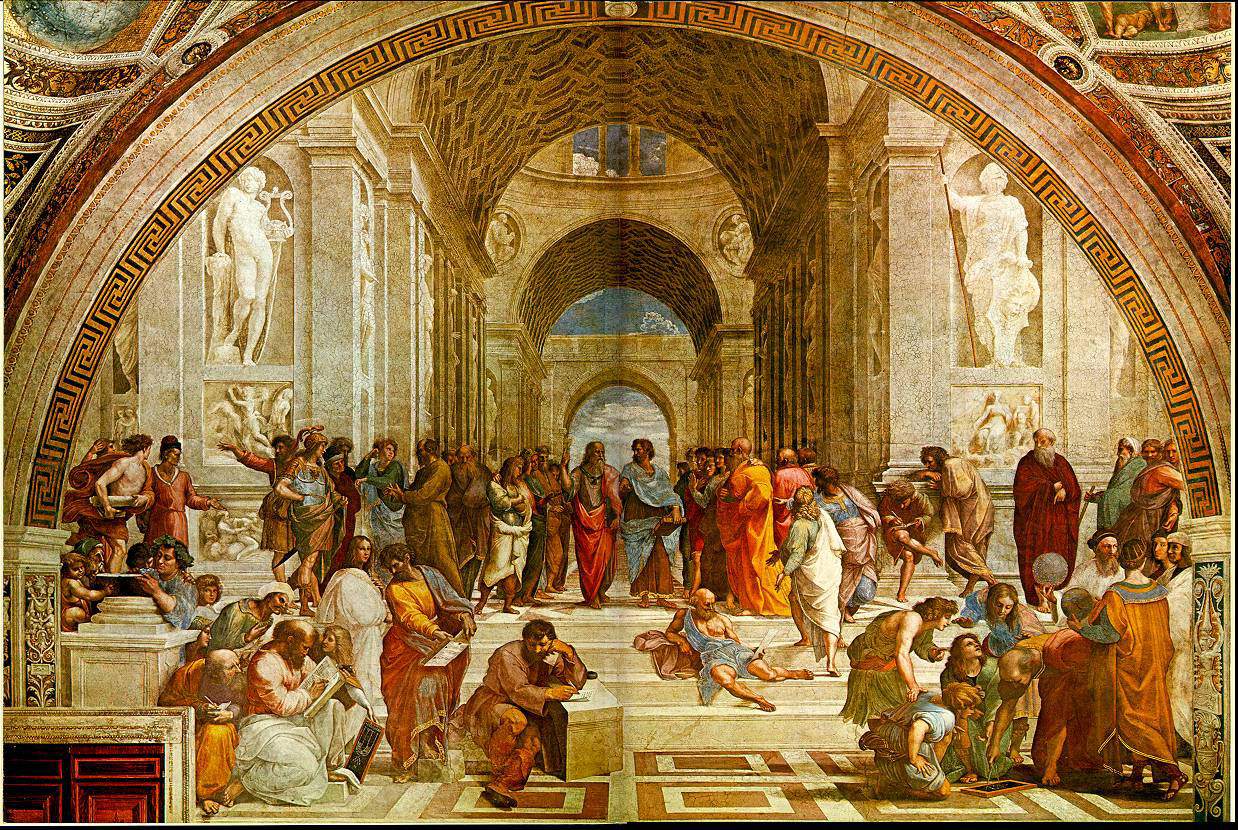
Raphael. The School of Athens. http://tomgpalmer.com/wp-content/uploads/legacy-images/School%20of%20Athens2.jpg.

Anonymous C. Stained glass cathedral window. www.fpcokc.org/aboutus/

* in order of presentation.

Bibliography

The 12th Century Renaissance. The History Guide. October 11, 2006. http://www.historyguide.org/ancient/lecture26b.html.

Age of Pericles. Wikipedia. April 21, 2009. http://en.wikipedia/wiki/Age_of_Pericles.

Akhenaten. Egyptology Online. 2008. http://www.egyptologyonline.com/akhenaten1.htm.

Anonymous A. Venus de Milo. http://www.mlahanas.da/Greeks/Arts/VenusMilo2.jpg.

Anonymous B. Arabesque. http://krsparks.files.wordpress.com/2009/02/frieze.jpg.

Anonymous C. Stained glass cathedral window. www.fpcokc.org/aboutus/

Castiglione, Baldassare. The Book of the Courtier. Trans. George Bull. London, England: Penguin Books Ltd., 1967.

Charlemagne and the Carolingian Renaissance. The History Guide. October 11, 2006. http://www.historyguide.org/ancient/lecture20b.html.

Florence Cathedral. Wikipedia. April 16, 2009. http://en.wikipedia/wiki/Florence_Cathedral.

Garland, R. Close Encounters. Lecture from series: The Integrated History of Ancient Greece and Rome. http://www.torrentreactor.net/torrents/2655216/The-Integrated-History-of-Ancient-Greece-and-Rome.

The Greco-Persian Wars. Classical Ideals. July, 2006. http://www.classicalideals.com/Greco-Persian%20Wars.htm.

Harlem Renaissance. World Book Reference Center. April 24, 2009. http://www.worldbookonline.com/wb/article?id=ar246340&st=harlem+renaissance.

Herodotus. Histories. Trans. A. de Selincourt. New York: Penguin Classics 1972.

Hindu Renaissance. Encyclopaedia Britannica. April 24, 2009. http://www.britannica.com/EBchecked/topic/266310/Hindu-Renaissance.

History of Augustus Caesar. http://www.historyworld.net/wrldhis/PlainTextHistories.asp?historyid=aa09.

Holister, Robert. Lecture. Viderunt Omnes. November, 2008.

Homer, translated by Robert Fagles. The Iliad. Middlesex, England: Penguin Books Ltd., 1998.

Italian (Petrarchan) sonnet. Wikipedia. April 22, 2009. http://en.wikipedia.org/wiki/Sonnet#Italian_.28Petrarchan.29_sonnet.

King Kalakaua. Aloha-Hawaii.com 2004. http://www.aloha-hawaii.com/hawaii/king+kalakaua/.

Michelangelo. The Creation of Adam. Sistine Chapel. http://www.success.co.il/knowledge/images/image-michelangelo-god-creates-man.html.

Morgan, Michael Hamilton. Lost History: The Enduring Legacy of Muslim Scientists, Thinkers, and Artists. Washington, United States of America: National Geographic Society, 2007.

Raphael. The School of Athens. http://tomgpalmer.com/wp-content/uploads/legacy-images/School%20of%20Athens2.jpg.

Urban Renaissance. Wikipedia. September 18, 2008. http://www.wikipedia.org/wiki/Urban_renaissance.

Walker, R. 1998. World Civilizations: A Comparative Study. p. 213-216, p. 260-286, p. 333-335. Oxford University Press, Don Mills.

What was the Islamic Golden Age? Wise Geek. 2009. http://www.wisegeek.com/what-was-the-islamic-golden-age.htm.
This is an essay which I wrote as part of my Comparative Civilizations 12 self-designed curriculum.

Observations of the Silent:
Investigating Neolithic Orkney

History is often studied through writings, but what happens when there are no writings to study? When the written word is lacking or is disputable, only one thing remains reliable: solid, physical evidence. While there is no written record of Neolithic Orkney, it is one place where there is a treasure-trove of evidence. On the main island of the Orkney archipelago, bordering the North Sea off the north coast of Scotland, there survive to this day examples of virtually every manner of Neolithic architecture to be found in Europe: stone circles, earthworks, stone chambers, standing stones, and the finest examples of Neolithic domestic residences to be found anywhere. Through the clues left by these extraordinary pieces of evidence we can derive a remarkable amount of information about the lifestyle, social structure, and beliefs of those who built and used them.
Under a sand hill known as Skara Brae, on the edge of the Bay of Skaill (1) on the main island of the Orkney group was found the most perfectly intact Neolithic settlement ever discovered. It was uncovered when a windstorm tore away the covering sand in 1850 A.D., and was excavated by Professor Vere Gordon Childe in the late 1920’s. Although Childe initially dated the site at c. 500 B.C., pottery comparisons conducted in 1939 by one Stuart Piggott showed that it must be older. When the site was finally radio-carbon dated in the 1970’s it was concluded that the site was within the range of 3100 to 2480 B.C., placing its occupation well within the European Neolithic (2).
The first most striking thing to note about the village of Skara Brae is its compact nature. Composed of at least ten distinguished buildings, each unified in size between 4.6 and 6.4 meters across (3), the village is entirely interconnected by a single tunnel. The structures are, and always were, semi-subterranean in the interest of shelter from the harsh Orcadian elements. The village was in fact built into a previous settlement of a similar nature, which had been abandoned at an earlier time and religiously filled in with midden. The stonework of the surviving settlement is notably skillful, using large slabs of stone carefully fit and arranged tightly together so that the ceiling curves to form a structure close to a dome. In such a small community, melded so closely together, there is no evidence of any form of hierarchy. Unless the settlement itself was a ‘palatial structure’, as historian Euan MacKie has put forth (2), the people who lived in Neolithic Orkney knew of no discrimination of social status. There is also absolutely no distinguished evidence to dictate that Skara Brae was such a palace, and the presence of a workshop, basins for the keeping of fishing bait, and the equality in size and intimacy in layout of the dwellings would indicate that the settlement was a simple village of work-a-day folk with little need for social structure. Indeed, with such a small population – Skara Brae could have housed a maximum of nine moderately sized families – a fixed elite would be neither sustainable or logical. The village would most probably be governed by the whole and must have been very co-operative judging by the layout of their settlement and the immensity of the projects that they engaged in.
While there may have been little or no class identification, was there any manner of gender inequality? Wood being scarce in the Orkneys, the people of Skara Brae furnished their dwellings with stone, including bed boxes which have lasted to this day. It has been noted that beds found on the left side of the houses tend to be somewhat smaller than those on the right, and that beads have been found in the beds on the left while being absent from those on the right (3). This has been deciphered to signify that women slept on the left side of the house in beds which were smaller than those of the men, and were therefore held in lower regard. This, however, is only one way of reading this evidence: it is possible that the beds on the left were occupied by children or individuals while the ones on the right were reserved for adult couples, causing it to make sense that those on the right should be larger. Perhaps beads were only worn by children or unmarried individuals in Orcadian society. It is difficult to come to a definite conclusion to a question such as this based solely upon the physical evidence available, but a study of the way the people lived, the challenges they faced, and the beliefs that they held may add to our understanding of it.
Judging upon a myriad of historical examples and logical reasoning, it can be seen that an emergence of social and gender inequality almost always occurs as a result of warfare, whereupon a caste of male warriors rises above the rest of society. There is every evidence that this did not occur in Neolithic Orkney. No martial weapons survive, and none of the many sites of the period are martially fortified in any way. The population of surviving settlements such as Skara Brae which date to Neolithic times could not have sustained warfare, and in the sparsely populated islands it would have been difficult and pointless to engage in conflict. The size of the settlements is also evidence that they must have maintained co-operative communications, as the workforce of several villages would have been required to work together in the construction of their substantial monuments. The various communities must also have intermarried, for the gene pools of such small concentrations of people would not have been sustainable for the amount of time that the settlements remained populated.
Everyday life in a village such as Skara Brae must have been very communal, although each house maintained considerable privacy. The individual dwellings once had doors, perhaps of wood, which could be barred by a slab of stone. Within each house was a separated cell through which ran a drain (2), probably used as toilets, demonstrating a very remarkable recognition of the importance of sanitation and individual privacy. Beyond this, however, there was probably little privacy within the family as everyone lived and slept in a single room which probably lacked partitions. Each dwelling appears to be physically and socially centered around a communal hearth, where most of the cooking, working, and socializing would no doubt have taken place.
The people of Skara Brae were obviously incredible artisans, as their architecture and implements show. Skara Brae had a specified workshop designated at least partially to stone working. Judging by the many stone chips found in this shop, craftspeople repeatedly heated and cooled their stone (2) to make it easier to carve. Much of the works of these craftspeople demonstrate a remarkable proficiency at their skill, especially small ornate spheres which were carved for an unknown but probably religious purpose (3). They were also incredible bone-carvers, using mostly whale bone which they shaped into beads, pins, bowls, and similar objects. While they did craft pottery which was decorated to some extent, their skill at this did not transcend practicality.
Upon close observation of surviving evidence it can be seen that the people of Skara Brae enjoyed considerable plenty. While they still practiced fishing, hunting, and gathering to a large extent, they also domesticated animals and farmed the land. Although only a small population of pigs were kept due to the lack of trees, the land was perfect for the herding of sheep and cattle making them the chief providers of meat, hide, fleece, and possibly milk. The villagers also hunted the wild game of the island, especially the red deer (1). They gathered limpets which they soaked in basins of water for use as fishing bait (2). They may also have actively hunted whales, or they may have simply taken advantage of the ones that beached themselves upon the shore. While they continued to collect plant foods such as nuts and berries in the wild, the villagers also practiced the agriculture of grains to feed both themselves and their livestock through the winter. One piece of evidence demonstrating the degree of plenty which was enjoyed is the lack of lamb bones to be found (2). In most primitive cultures that experienced winters as harsh as those in the Orkneys, most of the young livestock would have to be slaughtered before the onset of winter because there was not a sufficient surplus of food to keep them alive until spring. Such was not the case in Skara Brae. That enough care and surplus was available to feed the lambs all winter long is notable indeed.
It would appear by the many surviving monuments that science and religion not only went hand-in-hand in Neolithic Orkney, but were practically indistinguishable from one another. Both, as we shall see, were remarkably sophisticated. Twelve kilometers from the village of Skara Brae is a prime example of one of them: a seven meter high human-made mound dating to 3000 B.C., known as Maes Howe. Within the mound of Maes Howe is a chamber, one of the typical types of religious monuments of the Neolithic Era. Entered by a nine meter long, one meter high passage, the chamber is 4.6 square meters on the floor and three meters high in the center of the dome (2). The whole is constructed of massive slabs of local sandstone, some as long as four and a half meters and as heavy as thirty tons (1), which slope steadily inward to form a dome. The physical labour required for such a project is impressive, but the technical knowledge and cunning that the designers must have had is mind-boggling. The fact that these Stone Age people held the knowledge of the mathematics of thrust and counter-thrust to the degree that they could design and construct such a sophisticated structure in a way that has kept it standing for five thousand years should be enough to make us look at them in a new light.
Historians have long called Maes Howe the tomb of a “Priest-King” (1), simply because other Neolithic chamber sites were commonly used as tombs. Other chamber sites of the Orkneys, however, were used as mass tombs, not for individuals who could be associated with a particular leadership role or an upper class. As for Maes Howe, it is ridiculous to label it as a tomb at all as the only human remains found within it were a few tiny skull fragments. What, then, was the purpose of Maes Howe?
The passage of the chamber is of such a shape and co-ordination that the light of the sun enters it only for eighty-one days of the year: the Winter Solstice and the forty exact days before and after it. The passage itself is aligned perfectly with several menhirs, two stone circles, and the location of the setting sun on the shortest day of the year (2). Such alignments can hardly be coincidental, and were obviously carefully calculated and religiously observed. All things considered, it would appear that Maes Howe was not a place of burial, but rather a place of ceremony and worship. The alignments of the passage also bear testimony to the Neolithic Orcadian’s reverence of the sun and value of universal interconnectedness.
One of the stone circles with which the Maes Howe passage aligns is the Ring of Brodgar, 2.4 kilometers away. Originally comprised of sixty megalithic standing stones, equaling a total of twelve thousand tons of stone, the circle took an estimated eighty thousand hours of labour to complete. There can be little doubt that it was erected by a society that was in close co-operation and had enough surplus to afford so much time devoted to their beliefs. Again, we can only marvel at the mathematical accuracy of the design. The Ring is in the form of a perfect circle, and historians such as Professor Alexander Thom have concluded that the designers based the layout upon Pythagorean triangles of whole numbers. Looking again at astronomical alignments, it has often been proposed that the Ring of Brodgar was used as an astronomical observatory. It is interesting to note that many astronomically-based religions that we have record of associate the sun with masculine energies and the moon with feminine ones, and the Ring of Brodgar lays notably equal importance on both. The Ring is surrounded by a ditch, three meters deep by 9 meters wide, which is crossed by two entrance causeways. One causeway is in the South-East, aligning with the sunrise on the Summer Solstice, the other in the North-West, aligning with the Winter Solstice sunset. Of even more interest is that the site is positioned perfectly for the observation of the lunar cycles, most notably the major lunar ‘standstill’ which occurs only once every 18.61 years (2). That the people who erected these stones had the dedication and tenacity to make the long and laborious process of observing, calculating, and constructing these projects shows just how much they were capable of and the deep value that these sites embodied for them.
It is difficult to determine the exact nature of the rituals that took place at these religious sites, but they were almost certainly in correspondence with the Solstices, lunar standstills, and other astronomical events. The notion that sacrifices of humans or animals were made has become acknowledged as a fantasy which does not predate the 19th Century (1), and there is no evidence to support the existence of this practice. Some record of Norse and Celtic rituals which took place at similar Neolithic sites later in history can still be found (2). For example, the Norse practiced their marriage ceremonies in the Rings of Stenness and Brodgar. The bride would swear her oath of love to the groom in the Stenness Circle, before all of the gods, and the groom would do the same for the bride in the Ring of Brodgar. Then the two would hold hands through a now-destroyed menhir which had a hole through it, sealing the marriage. Another account tells of a Norseman passing nine times around the Ring of Brodgar on his knees as an act of either worship or penance. According to Julius Caesar in the 50’s B.C., the Celts of Britain held a great festival near Stonehenge once a year, which consisted of great revelry to celebrate the visitation of the “Great Goddess”, apparently their principal deity. It is unknown just how much these ceremonies reflect those of the builders, but they may offer us some insight into the nature of the earlier practices which may have influenced them.
It is difficult to discern why the monuments and settlements of the Orkneys were abandoned as they were, but they were surely left in a calm and deliberate way. The village of Skara Brae was ritually filled in with consecutive layers of the occupant’s belongings and midden so that it could not be reoccupied (2), just as the previous village that it was built on top of had been. It may be that a change in climate for the cooler and the clouding of the skies caused them to migrate to a more temperate climate with clearer skies to continue their astronomical observations. Some mysteries we cannot solve with anything more than speculation.
Silent as they are, the monuments of Neolithic Orkney can tell us much about those who erected them. They tell of a time and place where humans were not their own enemies. They tell of the extraordinary feats that humans can accomplish when they live in mutual co-operation. They tell of a people who, great as they were, felt honoured and humbled by the skies above them. They tell an amazing lesson which speaks to us across the millennia, a lesson as important today as it has ever been.


Reference Citations

1. Linklater, E. 1965. Orkney and Shetland: An Historical, Geographical, Social and Scenic Survey. p. 20-26. Robert Hale Ltd., London.

2. Marshall. 2004. Europe’s Lost Civilization: Uncovering the Mysteries of the Megaliths. p. 7-19. Headline Book Publishing, London.

3. Ingpen, R, and P. Wilkinson. 1990. Encyclopedia of Mysterious Places: The Life and Legends of Ancient Sites Around the World. p. 21-25. Viking Studio Books, United States of America.

Bibliography

Ingpen, Robert, and Phillip Wilkinson. Encyclopedia of Mysterious Places: The Life and Legends of Ancient Sites Around the World. United States of America: Viking Studio Books, 1990.

Linklater, Erik. Orkney and Shetland: An Historical, Geographical, Social and Scenic Survey. London, Great Britain: Robert Hale Ltd., 1965.

Marshall, Peter. Europe’s Lost Civilization: Uncovering the Mysteries of the Megaliths. London, Great Britain: Headline Book Publishing, 2004

Walker, Robert. World Civilizations: A Comparative Study. Don Mills, Canada: Oxford University Press, 1998.

Neolithic Europe. Wikipedia. March 18, 2009. http://en.wikipedia.org/wiki/Neolithic_Europe.
A History of Communication Methodologies in the Western World

By Bradley Albert Clements


If someone wanted to communicate with another person in the modern world, how would they do so? There are various methods: one could e-mail them, write them a letter to be delivered by post, travel to their home to speak with them in person, or one could pick up a telephone and call them. Today these are simple methods that are not foreign to most people. However, with the ease of modern communication easily at hand, it is easy to forget that these technologies have been long in the making; growing throughout history upon the shoulders of pre-existing traditions and innovations.
Probably the first and most important of communication innovations was discovered by humanity’s early ancestors: speech. Anthropologists believe that early humans had the ability to communicate by speech 60,000 years ago (World Civilizations: A Comparative Study). Since then, language has been the primary method of inter-human communication. Oral traditions eventually developed the practice of verbally re-telling histories and mythologies. These traditions grew and soon became highly formalized and were often considered very sacred (First Nations Novel Study Module). Perhaps the pinnacle of oral tradition in Europe was the epic poetry and drama of the ancient Greeks - works of such artists as Socrates, Aesculus, Euripides and Homer - which were recited by memory. The popularity of oral tradition reached another high during the Middle Ages through the performances of the troubadours.
The spoken word gave virtually everyone the ability to communicate, but it had its limitations. The use of speech allowed anyone to speak with anyone else within shouting distance, but words could not be conveyed to a distant place or preserved for future reference. While the conventions of oral tradition attempted to perpetuate stories, and messenger were entrusted to the carrying of verbal news across geographical space, neither could be consistently relied upon. And so writing was developed. The idea of writing first emerged in ancient Sumer before 3000 B.C. (http://www.ancientscripts.com/sumerian.html), although visual representations of physical things could be seen in cave paintings as early as 35,000 years before (http://www.citrinitas.com/history_of_viscom/rockandcaves.html). The basic writing that appeared in Sumer were originally pictographs, simplified representations of the things which they stood for. They were used to faithfully record trade agreements, and were thusly generally only striving to represent physical goods such as oxen, arrows, grain and bricks. Soon, however, the vocabulary of writing widened to include abstract and conceptual ideas. As this occurred the complexity of writing increased tremendously, resulting in such sophisticated systems as Mesopotamian cuneiform and Egyptian hieroglyphics. As a way of simplifying writing, syllabic systems were developed, in which each symbol stood for a single syllable, the building-blocks of words. Writing was finally fully simplified by the ancient Phoencians in c. 1050 B.C. (http://en.wikipedia.org/wiki/Phoenician_alphabet#History) when the alphabet was invented and used to represent individual phonetic sounds. The Phoencians were a seafaring trading people of the ancient Mediterranean and they spread their new alphabet concept to many surrounding cultures, including the Greeks who later influenced the Romans (Lecture, Professor Robert Garland). The Romans used their adaptation of this writing across their Empire, spreading its use throughout Europe and the Mediterranean world.
Writing came to be used for all manner of records, whether economical, historical, personal, religious or communicative. It too, however, had its drawbacks. Illiterate populations vastly outnumbered those who could read throughout most of history, meaning that writing had a very limited audience. Those with the ability to read and write were regarded, at the very least, as notably intelligent, if not as mysterious and mystical. The rampancy of illiteracy was largely because of the shortage and expense of written material. Books were slow and tedious to write and copy by hand, a task that only literate and highly skilled craftsmen were capable of. It is estimated that, during the Middle Ages, it would take an entire year to copy a single Bible (Lecture, Dr. Kwakkel). These problems were minimized by the perfection of the printing press and movable type by Johannes Guttenberg around 1453 A.D. (World Civilizations: A Comparative Study) which made printed material quicker, cheaper, and easier to produce. More people from more social classes gained a reason and ability to read as printed material increased in quantity, accessibility, and reliability and communication became much more reliant on the written word. The ability for average people to communicate from place to place, to publish their ideas to a wide audience and to educate themselves strengthened the rise of democracy and the middle class.
The combined methods of communication which had been developed prior to the 20th Century made communication possible to a remarkable extent, but all of these forms were bound by their physicality. Oral communication was only possible face-to-face, and written material – whether copied or printed – had a physical form which had to be transported to the audience, or which the audience would have to transport themselves to. Innovations in telecommunications, developed in the 20th Century removed many of the physical limitations which had previously posed as barriers. The electric telegraph, first invented in 1809 and refined to usability by Samuel Morse in 1844, paved the way for the ground-breaking inventions to come. The telephone, generally credited to have been invented in 1876 by Alexander Graham Bell (http://www.ideafinder.com/history/inventions/telephone.htm), made it possible to transmit verbal messages unhindered by geographical separation. Around the end of the 19th Century, Guglielmo Marconi (http://inventors.about.com/od/rstartinventions/a/radio.htm) proved and practiced the use of radio waves to transmit wireless messages and sounds through the use of radio waves, a discovery that led to the radio. The television made drama and other forms of oral tradition available to audiences around the world. Audio and audio-visual recordings had the ability to perpetuate oral traditions beyond the capacity that silent letters were capable of. With the development and cultivation of the internet in the 1970’s and 80’s, the ability of the general public to publish uninhibited information to a world-wide audience surpassed the degree that any previous innovation had achieved. New methods of direct communication became possible through the use of the internet, such as e-mail which allowed digital messages to be delivered instantly between any individuals with internet access.
It can be seen that inter-human communications have been developing for as long as they have existed, building upon the foundations of previous innovations. Writing could not have been developed without language, printing could not have come about without the methods of writing which preceded it, and telecommunications and the internet would probably have been impossible without all of the previous breakthroughs. While each consecutive innovation worked on the weaknesses of those which preceded it, no one technology has been universal enough to completely replace another. Whenever someone sends a letter or an e-mail, reads a book or a website, or chats with a friend in person or on the phone, they are tapping into a continually evolving heritage which is older than history itself.

Bibliography

Bridgeman, Joan. First Nations Novel Study Module. Victoria, British Columbia: Open
School BC, 2005.

Garland, Professor Robert. Lecture series: The Integrated History of Ancient Greece and
Rome. http://www.torrentreactor.net/torrents/2655216/The-Integrated-History-of
Ancient-Greece-and-Rome.

Homer, translated by Robert Fagles. The Iliad. Middlesex, England: Penguin Books
Ltd., 1998.

Psalm 7 from a 15th Century Book of Hours. The Illuminated Manuscript Company.
May 22, 2009.
http://www.illuminatedleaves.com/images/Spring%202008/5196mainlarge.jpg.

Internet. The Great Idea Finder. 1997-2007.
http://www.ideafinder.com/history/inventions/internet.htm.

Kwakkel, Dr. Erik. Lecture: Medieval Manuscripts. March 13, 2009.

Phoenician alphabet. Wikipedia. May 16, 2009.
http://en.wikipedia.org/wiki/Phoenician_alphabet#History.

Radio. About.com. 2009. http://inventors.about.com/od/rstartinventions/a/radio.htm.

Rocks and Caves. History of Visual Communications. May 18, 2009.
http://www.citrinitas.com/history_of_viscom/rockandcaves.html.

Sumerian. Ancient Scripts. 1996-2007. http://www.ancientscripts.com/sumerian.html.

Telegraph. About.com. 2009.
http://inventors.about.com/od/tstartinventions/a/telegraph.htm.

Telephone. The Great Idea Finder. 1997-2007.
http://www.ideafinder.com/history/inventions/telephone.htm.

Walker, R. World Civilizations: A Comparative Study. Don Mills: Oxford University
Press, 1998.
The Enlightenment of the Arrow

The bow – a simple piece of flexible material, bent and strung under tension – has shaped human history. Our early ancestors of the Mesolithic Era painted depictions of hunters carrying it on cave walls. The gods of innumerable early mythologies carry it. The Pharaohs, god-kings of ancient Egypt, fought and hunted with it. The Tartars of the Mongolian steppes conquered vast areas of Europe and Asia with it. The yeomen of medieval England revolutionized the Western world with it. The Zen monks of Japan found enlightenment in it. Now, hundreds of young Canadians like myself take it up every Saturday morning to practice the sport which embodies the legacy of our ancestors.
Hockey may be the sport which best represents Canada, baseball may be the national pass-time of the United States, soccer may be popular in France and cricket in the United Kingdom, but if one were to search for a sport to which the entire world could be identified with, what would it be? Archery may be the only sport to which almost every country on Earth has its own traditional affiliation with. The bow and arrow is a weapon, a tool, a piece of sports equipment, which is native and integral to virtually every tribe, culture and civilization of the world. Australia is the only populated continent to which archery is not indigenous, but even there archery has flourished since its introduction. Every nation has its own unique history of archery, and many would appear to have invented the bow independently.
My own introduction to the sport of archery began in the Melanesian archipelago of Vanuatu, while visiting there with my family in 2003. There, on an island enrobed in rainforest, a native man made me a bow and a set of arrows. The bow was a long rounded staff of pale wood, tapered to sharp points at both ends where the cord of twisted banyan-tree bark was tied and looped. The arrows were of a straight, light, smooth cane, notched at one end to fit the string and bearing a large hardwood blunt on the other, which was traditionally intended to stun birds. It was with these, the most primal of weapons, that my love for archery was born.
Returning to my hometown of Victoria, British Columbia, I sought out an archery club where I might be able to pursue the sport further. I was fortunate to find the Victoria Bowmen, an international level club that had hosted several prestigious competitions and had an excellent Junior Olympian Program (JOP). There I received much beneficial coaching and integrated into a diverse group of fellow archers. Members of the club practiced all forms of archery, from traditional longbow to modern compound, and were of all ages and walks of life. I made friends not only of my own age, but also some as young as eight and as elderly as eighty. After a year in the club I began volunteering as a Junior Representative on the board of directors, helping to organize fun-shoots and other activities for the JOP. I also took courses in Judging and Coaching and became certified in both. This led me to become an assistant coach at several recreation centers in town, and to continue the cycle of teaching and learning.
Once I had gained a suitable degree of skill, experience and confidence I began to shoot in notable tournaments. The challenge and experience of the tournament inspired me to travel around the Province and compete on various levels. After less than a year of formally practicing I was off to Kamloops to take part in the B.C. Summer Games, which put me to the test and introduced me to young people of many disciplines of archery. It was a very educational experience which I enjoyed greatly.
Archery offers these experiences – and many others - to everyone. I myself am able to enjoy it despite having poor distance vision, and in my time coaching I have taught people with fused wrists, others with stiff backs, and one with no fingers. Other successful archers of whom I know shoot from wheel-chairs, or with the aid of a mechanical release mechanism due to the loss of an arm. Archery stands among the first sports in which women were permitted to compete in the Olympic Games, and an archery club in Ottawa was the first sports club in all of Canada which was intended solely for women. Throughout its history, archery has proven to be a remarkably inclusive, democratic sport.
Today, archery brings a discipline, a stillness, a communication to the mind, body and soul in a world where the ability to find that space is all too rare. Far from being the flashy, violent, exertive activity portrayed in films and video-games, it is a sport which allows young people to take control of their bodies and quite their minds. When one places an arrow upon the string of a bow and draws it to the jaw, one becomes aware that their entire life has lead up to the immediate moment, and that the ensuing shot bears the weight of all history. All of the hurry and rush of the modern world must come to a halt when the bow stands bent with the energy of a coiled snake. Then, without a sound, the string is gone. It is said that when one finds the space in which the arrow leaves the bow they have found the enlightenment of the universe.