September 6, 2009
September 2, 2009
Cross-Canada Trip Pictures
Fossilized Tyrannosaurus Rex skeleton

Missive #3: On the Road!
September 2, 2009
Hey everybody!
“Is it not a fine thing for two Roman consuls [Cicero and Pliny the Younger]…to employ their leisure in arranging and dressing up a pretty missive, in order to gain a reputation for a good knowledge of the language of their nurse? …If the deeds of Xenophon and Caesar had not far surpassed their eloquence, I do not believe they would ever have written them down. They sought to recommend not their sayings but their doings.”
Michel de Montaigne (1533-92)
Well, so far I well deserve the scorn of Monsieur Montaigne, for I have done much more saying than doing. That should be amended herein!
I had just put dinner in the oven on July 30th when a knock came at the door and Bill and Maureen with Sam and Ellie rolled in with their luggage, having just returned from China. Once the baggage was through the door and we had exchanged hugs and greetings – exhausted as they were after 26 hours of travel – they retold their many amazing adventures to me over dinner. The next day – which was a continuation of a procession of beautiful sunny days – was Bill’s birthday and we went for a swim in Beaver Lake and a party at Derek and Joanne’s place. Migrating up to Derek’s studio, he put on a vinyl record of the Yard Birds and we joined in enthusiastically on drum kit, tambourine, and electric and resonator guitars.
I spent the beginning of August studying Kiswahili, learning some new classical guitar repertoire, and honing my rapier lunge. Nonetheless, after months of hectic school-work, fundraising, and preparing and packing for my trip, it seemed like I had finally reached the still-point at which there was little left to do. All of my projects were finished or packed, I lacked time to start any new ones, and I was getting antsy for movement. I was on the road soon enough, though: on the first Wednesday of August I caught city buses and the giant new ferry to Vancouver to meet up with Mom, Dad and Harry who had driven across Canada to visit in BC for the Summer holidays. I waited for them in the foyer of the Vancouver Art Gallery where Dad was viewing the show of Rembrandt, Vermeer, and other Baroque art. When they walked into the foyer they didn’t notice me until I was right in front of them and Harry leaped in the air and did a little scream, seeing me for the first time since Christmas. We drove through Vancouver and Stanley Park, then headed for the Horseshoe Bay ferry, Dad pointing out scenes from his childhood all along. Once there, we parked in the ferry line-up and I pushed Harry on the swings in the park. We had fish and chips at Troll’s Restaurant under the cedar sign that Dad had carved and painted when he had lived here, for Garry Troll, the owner. On the ferry to Langdale Harry clasped to my arm and unceasingly read me my driving manual despite my efforts to shake him off.
Once there we drove to Gran’s co-housing village where I slept two nights on her garden porch. During our stay, Dad and I helped to clean up Gran’s garden, Harry drug me off to play many games of ping-pong and bocce at the village Common House, and I looked at Gran’s collection of the family’s books, many of which bore beautiful but deteriorating bindings dating to the 1800’s. We met Gran’s friend Sally who lived a couple of doors down and planned to host a pair of Canada World Youth participants in September. She owned a viola and cello which her uncle had hand-crafted, both of which were beautiful to the eye and the ear, and we played together.
After a nice stay with Gran we drove to Madiera Park where we met with one of Mom’s cousins, Pat, who had lived in the same childhood neighbourhood, and his wife, Marie, on their powerboat. Uncle John brought the Carlisle over from Garden Bay and rafted up to visit. Uncle Rick and three-year-old cousin Alice came over with Lilly the spaniel as we were leaving and invited us to a BBQ party at a friend’s place to watch the hot-rod and classic car parade. Harry and I took turns keeping an eye on little Alice who had a great time swinging twenty feet in the air on the long tire swing, jumping on the trampoline, and sliding on the slide. When the parade began everybody sat on the curb and watched the huge variety of cars roll by. The younger boys made a sign which read “Burn Out!” and yelled “Lay rubber!” and pumped their fists for the drivers to honk their horns. A few drivers were happy to oblige and screeched by in a cloud of tire smoke leaving a black trail behind them on the road. Afterwards, as we drove back to Rick and Lisa’s, many people still on the roadside gave us the thumbs up or exclaimed “What the hell is that thing on that car?” in reference to Dad’s stream-lined plywood luggage rack that he had made for the roof-racks and decorated with hot-rod flames.
Rick and I slept aboard the Orythia, and in the gray-misted west-coast the morning I disturbed a huge blue heron out of a tree. I went to visit my great-aunt Shendra down the road and had an enjoyable visit. Back at Rick’s place, Alice was in one of her many pretty dresses and wanted to jump off of the dock, but daddy Rick told her to stop showing off and wait until she had her bathing-suit on. Once they both did, Rick did back-flips off of the dock and Alice copied him and swam around to the ladder, without the aid of a life-jacket, while laughing and spouting jets of water at Dad. Uncle John brought the Carlisle around to Bargain Harbour and rafted to the Orythia, braving the heavy seas and 30 knot winds that blew outside but which were completely cut out within the bay. We all visited and had dinner together.
The next day Rick, Alice, Lilly, and the lot of us, drove up to the cabin which Uncle Rick is building in Lund. Mom, Dad and I visited with our Aunt Rosemary and her husband Jeff in Powell River, while the others went swimming. At the cabin Mom and I made dinner and we all went for a trail-run through the forest. Alice had a great time in her jogging stroller as Rick barrelled along over the rough path, but she soon wanted to use her own legs to prove that what boys who are from four- to nineteen-times her age can do, she can do at least as well. She ran along and, although she fell often, she was always back on her feet and at it again without a complaint. We reached the trail end and rested on the rocky bluff looking out over Savary Island.
We slept the night in the cabin, and drove back to Powell River the next day to catch the ferry to Comox on Vancouver Island, and drive to Port McNiell to catch another ferry to Alert Bay on Cormorant Island to visit our friend Dorothy. Dorothy was a magnificent hostess for the three days that we stayed, feasted, conversed, hiked, and visited with her and other friends around the island, old and new. We also visited with our good friends Jamie and Vicki Taylor and their grand-daughter Amethyst. Harry and I helped the boy next door to Jamie to put up a zip-line between the trees, which was great fun for those light enough to ride it until the block became to hot with friction to use.
On the 13th of August we bid farewell to our friends and drove back down island, catching the ferry that Jamie was First Mate aboard. Entirely unannounced, we stopped in to say hello to Dad’s friends Pat and Beverly. Having tried and failed to contact us three days previous, and having just returned and being just about to leave again for holidays, they were very surprised to see Dad’s face peering through their glass door after years without contact. They had some very nice antique furniture, vinyl records, and books. Most of the books dated to the 18th and early 19th Centuries, as well as a 16th Century bible. Continuing down we stopped in Cowichan to visit our Aunty Bobby who was very happy to visit with us. We descended the Malahat as darkness thickened and arrived at Bill and Maureen’s place around 10 pm. During my time away my official driver’s license card and graduation certificate had arrived in the mail.
The ensuing days consisted of much visiting. Harry played golf every day with Bill. On Friday, as Mom and I were going about town running errands we ran across our friend Andrea. On Saturday Dad drew me as I shot my final practice at the Victoria Bowmen archery range, after which we went out for lunch with Mom’s step-aunts and uncles, Norman, Doreen, Marion, and Roy. From there we went to visit life-long friends Eric and Susan and their children Terrence and Eleanor, before going back to Bill and Maureen’s for a somewhat impromptu party. Many of our closest friends from the Victoria area came and contributed to the potluck feast. When we were finished discussing history, philosophy and periodic tables with Eric, Allison taught Alex and I to play “Killer Bunnies”, and Harry and Angus soon joined us in the very imaginative and giggle-inducing card game. Barry and Angus took turns on the guitar and keyboard, I played guitar and violin, and Dad got some drums together and we swung “I’ve Got Rhythm” and some other fun tunes. The following day was my final fencing practice before leaving, so I challenged all comers and faced all six of those who arrived one after another for two and a half hours. By the end I was drenched in sweat, but it was fun!
Ken, Peggy, Kenny and Will, our sailing friends from S/V Zeeotter whom we had met in Fiji, drove up from their home in Washington to see us. After meeting them at the M/V Coho dock we toured Fisherman’s Wharf, our old neighborhood from our days on Silent Sound, then went to camp at Aunty Mary’s ranch in Goldstream. For three days Ken, Rob, and I played guitars, Harry and Carter golfed, us kids hiked, trampolined, and swung on swings, while we all camped out and enjoyed eachother’s company. Mom, Dad, Bill and I went to Herman’s Jazz Club for Noah Becker’s birthday jam. The music was from a broad range, and was all very, very fine. As we left Noah, who had been Mom and Dad’s best man at their wedding, asked everyone to give a hand to his friend, a great artist, who was returning to Ottawa! The next day the former Silent Sounders and Zeeotters all congregated aboard S/V Greybeard for a meal with Humphrey and his many usual guests.
The time finally came for us to bid farewell to Victoria. We said goodbye to Aunty Mary, Matthew, Carter, Ken, Peggy, Kenny and Will, then drove to Bill and Maureen’s place to pack the last of my stuff into and onto the car. We miraculously succeeded, with my backpack between my feet, and my guitar and violin cases forming a wall in the demilitarized zone between Harry and I in the back seat, then drove to Deep Cove to visit with our friends Fran and Helen. As expected, we didn’t fit on the 5 o’clock sailing to Tsawwassen from Swartz Bay, but we caught the next ferry at 6. As the ferry pulled away from Vancouver Island, I left behind my archery club, spiritual community, SCA branch, and many other family and close friends.
After spending the night at Dad’s very hospitable cousin Shelley’s place in Vancouver, we drove up into the mountains where the slopes were inhabited by pine trees and the clouds were low over us. During our stay at Grumpa and Nana’s in Princeton there was a traditional music festival which we very much enjoyed. The festival kicked off with a Celtic street dance on Friday night which my poor calves (having just recovered from my last fencing practice) protested for days after the tip-toe springing dances, but the fun was, again, worth it. Between dances a man came up and introduced himself to Mom and I, saying that he had been sworn as a Canadian at a citizenship ceremony which Mom had administrated and I had played guitar at! Mom recalled the thank-you card that he had sent. For the following days Mom, Nana and I listened to the back-to-back performances of Celtic, country, ballads, shanties, clog and morris dancing, and other traditional music, dancing and story-telling. Saying goodbye to Grumpa and Nana, we got in our high-piled car and drove through the smooth rolling Okanogan scenery like an Arabian caravan camel en route to Mecca.
Reaching our friend's Jim and Chris' place in Kelowna, we stayed there two nights. Jim drove Dad and I out to the airport to see his beautifully home-constructed little yellow aircraft. After our stay we continued on, and the sharp gray crags that stood sentinel over Kicking Horse Pass looked down from above us as the Rocky Mountains bore us over their backs. As we drove along the highway, passing road workers and century-old railway-tracks, I looked into the valleys far below and wondered at the perseverance that the first pioneers into this region must have had. Stopping at a gas station to fuel up, we found a tanker truck filling the station which had run dry. Apparently many stations had due to a tornado, and the tanker had to come from Vancouver. Once there was gas, it ran very slowly, at less than a letre per minute. We left the sun in British Columbia as we descended down the slope into the Prairies, and we opted to spend the night in a Calgary motel which smelt of cigarette smoke rather than drive till midnight and set up camp in our destination of Drumheller. The car gave us a little scare the next day, when it refused to start after we had stopped for breakfast, but Mom got it going just as Dad was going to phone for help.
Continuing on to Drumheller, we sank below the sedimentary layers of the pre-historic valley and model dinosaurs began appearing on the sidewalks as we entered the town. We drove to the Royal Tyrrell Museum, Canada's only museum dedicated to palaeontology, which houses dinosaur finds from Alberta and the world. Having visited the museum during my dinosaur-craze era sixteen years ago, a few of the exhibits were vaguely recognizable. Although my craze was long over, it was still fascinating and Harry loved it too.
We set up tent at a campsite, apparently next to a river although there was a fence and dike between us and it. Mom, Dad and I went for a short hike up into the Badlands, the mystical desert of hard, rolling hills. The next morning we set off across the province, driving through vast fields of wheat and canola and past the emotionless mechanical arms of oil-well pumps. We stopped at a lookout over Horse-Thief Valley, and Harry fell in love with the local gopher community who scampered up to eat nuts and raisins out of his hand. As he broke pieces off of a cookie to feed one, it grabbed the whole cookie and ran off to sit next to it's burrow, holding it between its two paws and taking bites out of it in a hilariously human-like fashion. We made it to our cousin Ken's place in North Battleford, Saskatchewan, and he put us up in his beautiful cabin on Jackfish Lake where we roasted marshmallows, swam in the lake, and visited. Finding avid golfers in one another, Harry and Ken hit it off and went golfing together the following morning. We went to the Fort Battleford National Park, where the Northwest Mounted Police had a fort during the 1800's. We witnessed a re-enactment of a rifle drill in the stockade, and went on a guided tour of the surviving fort buildings. We then returned to Ken's place where a minor Holliday family reunion was underway. Ken's son, Rob, daughter, Joanna and her family, and brother, Lenn, were there and I much enjoyed meeting everyone. Having always been very interested in history and genealogy, I loved meeting Lenn who had done extensive research of the Holliday family going back to the late 1700's.
After a wonderful stay in Battleford, we continued across Saskatchewan, camping the night in Manitoba. The roads on the prairies are so flat and straight that people joke that if you fall asleep on the highway you won't crash, you'll just run out of gas! When we entered Ontario the scenery became much more interesting, with low hills, young forests, and many beautiful little lakes and rivers. We sited a wolf, a coyote, a porcupine, two moose, some snakes and many birds of prey. One campsite that we stayed at had an ominous statue at its gate of a giant mosquito bearing away a camper for dinner. In actuality the mozzies were of an average size, but they made up in numbers for what they lacked in individual size. As Mom had only learned after booking her holidays that Harry's school began a full week before Labour Day, we were in a bit more of a rush to get back than we would have been. For that reason we drove long and hard the next two days and stayed at a hotel to avoid camp set-up and take-down time, and he only missed the first day of school.
Arriving at the house in Ottawa, we found the front lawn well maintained and the garden growing well, as our neighbour, Greg, had been looking after Clouseau and the house. Going through the front door, I whistled for Clouseau and a loud meow was heard from up the stairs. He came down and seemed very happy to see us.
So the next week or so I'll be working on college preparation stuff for next year, and doing last minute shopping, packing and preparation for my Canada World Youth exchange. I'll be off to Toronto on the 9th for the CWY orientation camp, so I am on the brink of yet another brand new experience! Crossing 6000 kilometers of Canada with my family was the perfect re-connective and self-discovering experience, and I finally feel that I have a sufficient connection to my country to be an ambassador to it. Mom, Dad, Harry and I need to thank all of our amazing family and friends across Canada who have hosted us and made us welcome in their homes and communities – I am honoured to know so many wonderful people!
For those of you who have long been wondering, I have been told where in Tanzania I will be going in December: a rural community called Chamazi located 25 km south of Tanzania’s largest city, Dar es Salaam. I have also been informed that I am the recipient of a $1000 entrance award to Camosun College when I return to study there in 2010. As I said, the Ontario half of my CWY exchange begins on September 9th, and you will receive all the news of that in my next Missive. This letter grows too long: it must go to the barber's with my beard!
Your Friend,
Bradley A. Clements
Ottawa, Ontario
August 24, 2009
BC Pictures
Banquo Folk Ensemble at the Princeton Traditional Music Festival
July 30, 2009
Missive #2: Bachlorship 101
Hello everyone!
Bill and Maureen having left for China, I have been looking after the house alone for the past month. This has been my first experience of living alone for any period of time and, school being done and all, it hasn’t been as difficult as anticipated. Thanks to the experience that Maureen gave me earlier, cooking has become an enjoyable necessity. I spent the first week of July coaching archery to a summer camp of handicapped children with Helena at the range. One day consisted of three classes between 10 am and 3 pm, totaling to about sixty kids! Despite the many hours spent searching for arrows lost in the shoulder-high jungle of thistles which have sprung up on the berm, I can’t complain: I’m helping the archery club, the kids and their organizations, and Helena who - having been an archery coach for around 30 years with world champions and universities - has given me a great deal of education. I’m also gaining important teaching experience myself doing something I love to do out in beautiful weather…. oh yeah, and getting paid!
On Canada Day I decided that I needed a bit of exercise, so I walked from Bill and Maureen’s place in Esquimalt around the harbour to Fisherman’s Wharf to visit some friends, then continued down Dallas Road to Beacon Hill Park where I listened to a jazz band performing. After the major concerts in front of the Legislature (including the World music group Pacifica), I watched the show of fireworks over the harbour. Walking back along Government Street, I ran into the ever-popular marimba busking-band and joined the throng of dancers who had made the street impassable. Eventually prying myself away from the joyful music and enthusiastic revelers, I walked back to Esquimalt and crashed into bed at half past midnight.
I must admit, however, that there are times when anyone can feel down, especially when there are several planets in retrograde. I was feeling somewhat touchy and resentful for a period, fed up by the greed and corruption of modern Western society and the lack of good Classical music on the CBC. When I begin to feel this way, there is but one fool-proof therapy: to submerge myself in history. To this end I went to the Royal BC Museum where an exhibit of some of the world’s most amazing artifacts from the British Museum was being displayed. I spent a total of about eight and a half hours over three days in the exhibit, marveling over the sarcophagi of Egyptian pharaohs, an ancient Corinthian helm, a collection of the Lewis chessmen, a fully articulated steel model of a Japanese dragon, and many hundreds of equally breath-taking artifacts from around the world and throughout history. Staring into the eyes of a bust of Marcus Aurelius, Roman emperor and Stoic philosopher, I recalled one of his sayings: “Very little is needed to have a happy life.” How true, Marcus!
I organized a fun-shoot at the Victoria Bowmen to help raise funds for Canada World Youth. Thanks to a great turn out of friends, including club members, SCA friends, and a teacher from SIDES, we had a great time shooting balloons, model animals and targets, and raised $130 in the process! The Friday music get-togethers were less well-attended, but Barry on guitar and keyboard and I on the violin and guitar had a great time fooling around with Celtic fiddle tunes, Gospel improvisations, pop songs, and a continuing list of unpredictable music. Between these events, many book sales (which raised about $1300), and kind donations from friends, family, my archery club, and the Lion’s Club of Esquimalt, I have reached my fundraising goal of $2500! Unfortunately I must close the Carlisle Avenue Bindery, so I can’t take any more book orders until after my exchange.
I’ve had many trips to the doctor’s, dentist’s, pharmacist’s, and optometrist’s offices for pre-trip check-ups, booster vaccinations, prescriptions, and my first filling in one of my adult teeth. I also finally got around to applying for my learner’s driver’s license, which I passed easily save the eye exam. As anticipated, my distance vision was not sufficient to drive, so I’ll have to get a new pair of glasses.
Mimi ninasoma Kiswahili! Yes, I am studying Swahili, Tanzania’s national language. I may not yet be able to string together a very impressive sentence, but I’m attempting to build a basic foundation which I can work up from once I get into the program. I should also set about oiling my very rusty French, as I will be expected to use it during the Canadian half of my exchange. Peter, our very kind, charitable, and community-oriented neighbor, got me into volunteering with the Rainbow Kitchen and Garden at St. Savior’s Anglican Church, a place where hundreds of homeless and low-income people can come to eat. I provided live music and helped with clean-up – it is quite enjoyable, and it is worth it for the thanks and the quantities of food that I am sent home with! In the free time that I have, I’ve been reading “The Expedition of Cyrus”, a thrilling 2400 year-old eye-witness account of the most amazing adventure story ever written. It is by Xenophon of Athens, an orator, philosopher, student of Socrates, and general of an army of Greek mercenaries that had to literally fight its way out of the center of the vast and hostile Persian Empire. A must-read if you are a fan of real-life adventure stories, or are just a history geek like me! I have also just finished listened to an audio-book of Virgil’s “Aenied” and Homer’s “Iliad”, and started listening to “Medea” by Euripides, reading parts of the Gnostic Bible and Dead Sea Scrolls, “North of South: An African Journey” by Shiva Niapaul, and a book of the complete works of Michel de Montaigne, the first essayist, who wrote during the French Renaissance. I enjoyed a performance of Shakespeare’s “Twelfth Night”, set in the 1920’s, on the grounds of Camosun College. On July 25th my fencing instructor and his girlfriend and I drove to an SCA event at Camp Bernard for the testing of a gallant candidate. The candidate was tested in many of the things that make up the Society for Creative Anachronism, of which we saw dancing, armor inspection, fencing, archery, and battle commanding. It was especially fun to have a rapier-oriented event, rather than heavy fighting, to give us fencers a chance to try some really fun and creative battle scenarios. Following that I went to the Luminara lantern festival, in which the element’s light-show far out-shone our feeble lantern art: the sunset dyed the overcast sky a luminous peach while lightening flashed behind a vertical rainbow, sending incredibly long peals of thunder rolling across the heavens.
That’s the news for this month! Bill and Maureen return today. Next week I will be catching the ferry to Pender Harbour and to meet and travel across Canada by road with Mom, Dad and Harry: a trip which I shall tell you of in my next Missive! Remember that if you’ve lost or missed any of my Missives, you can find them – along with many other letters, stories, and essays – archived on my blog, bradleyclements.blogspot.com.
Hope you’re all having a great summer, and I hope to continue to hear from you!
Your friend,
Bradley Clements
CWY Volunteer
Victoria, BC
Sponsored by the Lion’s Club of Esquimalt, the Victoria Bowmen Association, and his many beloved friends and family!
July 4, 2009
Missive #1: Graduation and beyond!
Hello everyone!
As you have probably heard, I have recently been accepted for a Canada World Youth (CWY) exchange between Ontario and Tanzania. The program will consist of full-time environmental volunteer work with a group of 18 youth and two adult supervisors - half from Tanzania, half from all across Canada. I will be paired with a Tanzanian counterpart with whom I’ll be living, and together we’ll be staying with a host family in a community in both Peterborough, Ontario, and in a village in Tanzania. My preparations are already underway, including sorting out travel documents, studying Swahili (the primary language of my exchange country), and engaging in an intensive campaign to raise $2500 for CWY. So far I have been blown away by the friendship, generosity and enthusiasm that so many of my friends and family have offered, and with their much appreciated help I have already come to about 70% of my goal within less than one month! I have raised a great deal of funds selling hand-made books, so Bill and Maureen’s suite where I am staying has been converted into a bindery of sorts. Many tireless hours have been spent stooped over stacks of paper to be cut, folded, pierced, sewn, covered, wrapped, and pressed. What I had been expecting to be the hard part, though – selling the books – hasn’t actually been so bad. Already this has been and immensely educational experience which will be especially valuable if I ever end up doing anything like this as a business.
So, many of you have been wondering how and why I came to be involved in Canada World Youth. I’ve been wondering that a bit myself, but I’ll explain to the best of my discernment. My interest in international volunteer aid organizations was first sparked in the South Pacific where I saw volunteers with such organizations as the Peace Corps working, especially in Vanuatu. Having been disgusted by many of the examples of - often pointless, sometimes harmful - “aid”, I was pleased to see that there were organizations which actually intermingled with the local society and worked for them and in accordance with them. Upon returning to Canada I went looking for a similar Canadian organization in which I might be able to participate, and I didn’t have to look far! My family’s one-time acquaintances, now good friends, Bill and Maureen have a son named Dylan who was away in Kenya on a CWY exchange when we returned from our trip. His experience seemed a good one, and he introduced CWY to me. After my family moved to Ottawa for Mom’s work, I began staying with Bill and Maureen. Last Fall we acted as host family to a pair of CWY participants, Melissa and Yulia, in a Victoria/Ukraine volunteer exchange, so I gained some experience of life in the CWY. Finding what I had seen to be important and meaningful, I applied for the program. However, it didn’t remain at the fore of my plans and was washed away by school and prospects of college/university. Thus I was surprised one morning to check my e-mail and find that I had been accepted. I hummed and hawed over it for a couple of days, then decided to accept and haven’t looked back since!
Apart from my preparation work for Canada World Youth, I am also just finishing my grade 12 schooling through SIDES (the South Island Distance Education School) with whom I have been studying since we returned from our trip in 2005. I’ve also been playing in the last of the school year’s Strings program, which I attend at Esquimalt High School. At the Strings Finale concert I was given a commemorative music folder. Grumpa and Nana attended our “Bach to the Beach” picnic/concert at Willows Beach, and I had the opportunity to visit with them and George Wood while they were in town. Allison (my girlfriend) invited me to the Esq. High grad dinner and dance at the Empress Hotel, so I got the experience of a genuine graduation celebration despite being home-schooled! We sat at a table with two of Allison’s friends and their boyfriends, one of whom had been my best friend in grade 3 and who I had not seen in ten years, or had contact with for at least seven… Weird synchronicities are everywhere!
My own graduation ceremony was on the 24th, and although my parents could not make it I was by no means alone: my Gran, Uncle John, Aunty Mary, Carter, Allison, Bill and Maureen all came, some of my closest family and friends. Despite a bit of adventure getting to the ceremony, involving my mixing up of the names of Cadboro and Cordova Bay, it was a great experience to see some of the amazing, diverse students who were graduating through SIDES. The teachers and everyone at SIDES deserve my deepest thanks for guiding me cheerfully, thoughtfully, and wisely through the quagmires of high school, for allowing me the ability to catch up for much lost school time during my travels, and for giving me an option outside of the physical school system. You are all amazing!
As for the rest of the family, they’re doing well in Ottawa. Harry’s enjoying scouts and baseball, and has a website called http://kiwibirds.webs.com/. Dad has his studio in working order and is creating art once again, which can be seen on his new blog http://clementsgallery.blogspot.com/. Mom is working in Citizenship Case Management in Ottawa, and has been on a work exchange to Trinidad. She has been offered another to Siri Lanka, but she has had to turn it down because the three of them will be traveling here to BC in August. Uncle John was in Vancouver General Hospital for surgery on his fractured neck, which went much better than anticipated. He is recovering rapidly and we are thankful for the many prayers that he has received! Silent Sound (yes, I still regard her as part of the family, even though she now has a new owner) is off for a new media-covered adventure over the Northwest Passage this summer, captained by her new owner Cameron Dueck. Their voyage can be traced on Cameron’s website, http://www.openpassageexpedition.com/index.html, where you can find information, live tracking, pictures, the latest up-dates of the expedition, and more.
So that’s the news up to now! Bill and Maureen left for China this morning where they will be traveling and visiting with Dylan who is there studying Mandarin at Shanghai University. I’ll be staying here in Victoria looking after the house and continuing with my fundraising and other preparations for my trip. There will be a funshoot at the Victoria Bowmen archery range on July 11th from 10:30 am till noon, by donation ($5 - $15 suggested) in support of CWY and my exchange. Everyone is welcome regardless of age, membership, and skill. There will be coaches to introduce you to the sport if you are new to it. Also, on each Friday in July, from 2 – 3:30 pm, I will be hosting a fun music session at Bill and Maureen’s place for the young and young at heart. All are welcome, regardless of age and experience (young children should be supervised) with a donation of $5 or more which shall go towards CWY. If you’re in the Victoria area and are interested in either of these events, just let me know and I’ll get you the details.
I will be trying to keep you in the loop with Missives such as this one roughly every month. I will also be posting these Missives, as well as photos and other updates on my blog, http://bradleyclements.blogspot.com/. My e-mail address is svsilentsound[at]gmail[dot]com, and my mailing address (until the end of August) is 1225, Carlisle Ave., Victoria, B.C., V9A 5C7. I’d love to hear from you! Also, I am still working to raise the $750 remaining before the end of July, so please let me know if you would care to contribute to CWY. I am gratefully accepting donations: a tax-receipt and a personal postcard from Tanzania will be sent to everyone who contributes $20 or more. The books are still on sale, between $10 and $35 – they make great gifts, journals, sketch-books, note-books, etc. Thanks for your support!
Your friend,
Bradley Clements
CWY Ontario/Tanzania Volunteer
Victoria, Canada
June 24, 2009
Essays
RENAISSANCE: REKINDELING THE PAST; SPARKING THE FUTURE
An Illustrated Essay by Bradley A. Clements
The word “Renaissance”, meaning a re-birth or re-vitalization, was first used to describe the Italian Renaissance of the 15th and 16th Centuries in Europe. The word has since come to be most commonly associated with any period of great cultural, intellectual, scientific and social prosperity arising from a suddenly renewed interest in the past. Under this definition it can be said that many notable renaissances have occurred around the world throughout the course of history, bearing comparable characteristics in their nature, rise, and aftermath.
While the word may have been first used in the context of the Italian Renaissance, the concept of a renaissance is far older. The first discernable periods of renaissance may be said to have been in the mid to late 700’s and 800’s A.D., with the emergence of the Carolingian, Macedonian, and Islamic Renaissances. However, it would seem that in ancient times the world lived in a virtually constant state of renaissance, of flourishing culture looking back at the past. Rather than only during the great state of revolution that were the later renaissances, ancient peoples always looked for identity and justification from the past. For example, conquerors often claimed a symbolic – if not actual – lineage from a previous notable general, as King Pyrus of Epirus who, in his war against the Romans in defense of the Tarentines, proclaimed himself a “latter day Alexander the Great” (1). Alexander the Great of Macedon, conqueror of the Persians, had in turn claimed a symbolic succession from Agamemnon of Mycenae who had led the Greek invasion of Ilium. The ancient value of heritage seems only to have been broken by occasional periods of revolution. The reinstatement of the traditional Egyptian polytheistic religion by Pharaoh Tutankhamun in 1336 B.C. after the Amarna Period of Akhenaten’s reign (2), the Athenian Golden Age brought about by Pericles in 448 B.C. after the two sackings of the city during the Persian Wars (3), or Augustus Caesar’s era of cultural excellence in the Roman Empire from 27 B.C to 14 A.D. following the Roman Civil War (4), could all be said to have been cultural and political renaissances. They were, however, merely returning to norms which had not been long dormant, and which had certainly not been forgotten.
Through an observation of some of the many renaissances of history, it can be seen that the genesis of a renaissance hinges very much around politics, often backed by a newly invigorated economy, inspiration from the outside world, and new innovations in communications technology. It must be realized, though, that these components merely act as the match which lights the fuse of a pre-existing creative culture.
The Islamic Golden Age of circa 700 – 1200/1600, as an example, was a renaissance which began and flourished under the encouragement of the Abbasid Caliphate. The caliphate supported the founding of many centers of learning, including the world’s oldest universities and the largest libraries which the world had ever seen, many of which were open to the public. In these places the texts of the ancient Iraqis, Romans, Chinese, Indians, Persians, Greeks, Byzantines, and North Africans were archived, translated into Arabic, and studied passionately. Due to the impressive size, wealth, and power of the Islamic Empire, commerce flourished and soon replaced warfare (5). With this new development the Empire became stable, prosperous, and the cross-roads of the world. These conditions provided an ideal breeding-ground for art and learning, with a broad base of wealthy patrons and available inspiration. Despite all other catalysts, the explosion of learning could not have become as wide-spread as it did without one new piece of communications technology: paper. Knowledge of the secrets of papermaking was revealed by Chinese prisoners in 751 A.D. (6), and allowed for a much easier, transportable, and more affordable medium to communicate information and ideas.
The Islamic Golden Age provides a fine example, and is nearly stereotypical when speaking of the birth of a renaissance. The Carolingian Renaissance, during Charlemagne’s reign of the Frankish Empire from 771 to 814 A.D. (7), was similarly inspired by the monarch and made possible by the stability of the empire which he had forged (5). The Italian Renaissance itself was based largely upon a stable commerce-based economy which empowered the arising middle class to give their patronage to the arts; based upon new innovations in communications technology, most notably in the form of the printing press; and based upon the competitive encouragement of political and religious leaders, perhaps the most famous example being the Medicis. The Elizabethan Era, England’s cultural renaissance during the rule of Queen Elizabeth I from 1558 to 1603, has come to be known by the name of the monarch who inspired it. The First Hawaiian Renaissance, from 1874 to 1891, came about due to the interests of traditional Hawaiian culture held by King Kalakaua (8), and more recent attempts to bring about renaissances, such as the Urban Renaissance in the United Kingdom (9), have been driven largely by government incentives.
Although many very diverse renaissances have occurred throughout history, they can all be defined as renaissances by specific characteristics of their nature which they hold in common. Note that many field-specific renaissances have happened over the course of history, such as the revival of Greek, Gothic and Tudor architecture and classical styles of painting and literature, but these cannot rightly be considered to be renaissances in the application of the term to an era of history in general. The most notable aspect of a substantial renaissance is in the arts and learning, often followed closely by science, religion, and many other attributes of society. While cultural developments occurred to varying degrees in different renaissances, the areas of development were often essentially the same.
As an example, the Italian Renaissance is recognized as one of the most remarkable periods in all of art history. More artists are recorded to have worked during the Renaissance than during any other period in European history (5), and innumerable striking and innovative works were created. But a few examples of works of art include the largest masonry dome ever erected, Brunelleschi’s Duomo in Florence (10); the Mona Lisa, the renowned portrait by Leonardo da Vinci, and the riveting Statue of David by Michelangelo. Revival of the classical ideals of realism and humanism led to studies in form and the discovery of perspective in the visual arts. Musical experimentation with the use of polyphony, discovered during the 12th Century Renaissance, resulted in awe inspiring motets by such composers as Josquin Desprez, Thomas Tallis, Orlando Gibbons, Giovanni Pierluigi da Palestrina, and Claudio Monteverdi, becoming the basis for all of Western Classical music (11). Literature reached new bounds. New works, such as Miguel de Cervantes’ ‘Don Quixote’, were created building upon the form of the novel which had been experimented with by the ancient Greeks, and the novella which had been the form of Giovanni Boccaccio’s 14th Century work, ‘The Decameron’. Poets and playwrights, such as William Shakespeare, made popular their antiquarian forms of literature. They perfected the use of rhyme and rhythm which had been resurrected during the 12th Century Renaissance, and the form of the sonnet which had been invented by Giacomo da Lentini in the 13th Century and immortalized by Francesco Petrarca in the 14th Century (12). Even the “lesser” arts, such as the martial arts, were revolutionized. The rapier evolved, a long thin sword adapted to the ancient Roman style of swordplay which was based upon thrusting. This new style of fencing took Europe by storm with many competing schools springing up across the continent, such as those of Capo Ferro, Agrippa, and Morrozzo. Not only were these many art forms growing and changing tremendously, they were also experiencing a demand that may not have been seen before or since. “Renaissance Men”, as they were called, although members of both genders were deserving of the name, were idealistic individuals which a passionate interest in a myriad of fields. Members of all of the courts of Europe were expected to fulfill these standards and be accomplished in all of the arts, as well as be courteous, tasteful, philosophical, and honorable, as outlined in such works as ‘The Book of the Courtier’ by Baldassare Castiglione.
New breakthroughs were made in the sciences of medicine, astronomy, mathematics, alchemy, and physics, despite the disapproval of the Catholic Church. Humanism led to a greater desire to find explanations through logic, science, and reasoning, rather than through the blind faith of the Church which had more or less governed Europe’s thinking for the past millennium. New philosophies emerged which criticized the Church to varying degrees. This eventually led to the Reformation which saw the rise of counter-Catholic dioceses such as the Lutheran Church and Calvinism, interpretations of Christianity which sought the original striped-down version of the religion.
The conclusion of a renaissance can be as abrupt or as gradual as its rising. An observation of the tendencies of various renaissances can lead us to believe that the more substantial the renaissance the more prolonged its outward transition and the more enduring its legacy. Historians still differ in opinion as to when between 1200 and 1600 A.D. the great Islamic Golden Age can be said to have ended (5). Only circa dates can be given for the period of the Italian Renaissance, partially because it ended at different times in different parts of Europe, but also because it melded so seamlessly into the Baroque. Other renaissances seem only to have endured under their protectorate, such as the Elizabethan, Hawaiian, and Carolingian renaissances, all of which ended with the reign of the monarch who initiated them. This is likely to have more to do with the surrounding circumstances than with the content of the renaissance, but it is notable.
Renaissances being periods of such cultural potency, it is not surprising to see that their legacies are long-enduring indeed. The 12th Century Renaissance, while little known today, saw the rise of today’s judicial and educational systems (13). In true renaissance nature, these innovations were inspired by the ancient Romans and Arabs, but were re-introduced and re-interpreted by the Renaissance scholars in a way which has made them immortal. The architecture of the 12th Century, the science and mathematics of the Greeks and Arabs, the religion that was first championed by Charlemagne in the Carolingian Era and the branches of it which emerged from the Reformation, the art of Michelangelo, the inventions of Da Vinci, the philosophies of Socrates, the language of Shakespeare, the politics of Castiglione and Machiavelli: the products of renaissances surround us each and every day.
One could say that history is a pendulum which is eternally swinging from extreme to extreme. Using this analogy, the centre of the swing is the Renaissance: the place that is in balance between the two worlds of faith and reason, nature and order, past and future. The Renaissance is the place of looking back and moving forward. In the words of one who lived during a renaissance, John of Salisbury in his ‘Metalogicon’ of 1159 A.D. (13):
“Our own generation enjoys the legacy bequeathed to it by that which preceded it. We frequently know more, not because we have moved ahead by our own natural ability, but because we are supported by the menial strength of others, and possess riches that we have inherited from our forefathers. Bernard of Clairvaux used to compare us to punt dwarfs perched on the shoulders of giants. He pointed out that we see more and farther than our predecessors, not because we have keener vision or greater height, but because we are lifted up and borne aloft on their gigantic stature.”
Reference Citations
1. Garland, R. Close Encounters. Lecture from series: The Integrated History of Ancient Greece and Rome. http://www.torrentreactor.net/torrents/2655216/The-Integrated-History-of-Ancient-Greece-and-Rome.
2. Akhenaten. Egyptology Online. 2008. http://www.egyptologyonline.com/akhenaten1.htm.
3. Age of Pericles. Wikipedia. April 21, 2009. http://en.wikipedia/wiki/Age_of_Pericles.
4. History of Augustus Caesar. http://www.historyworld.net/wrldhis/PlainTextHistories.asp?historyid=aa09.
5. Walker, R. 1998. World Civilizations: A Comparative Study. p. 213-216, p. 260-286, p. 333-335. Oxford University Press, Don Mills.
6. What was the Islamic Golden Age? Wise Geek. 2009. http://www.wisegeek.com/what-was-the-islamic-golden-age.htm.
7. Charlemagne and the Carolingian Renaissance. The History Guide. October 11, 2006. http://www.historyguide.org/ancient/lecture20b.html.
8. King Kalakaua. Aloha-Hawaii.com 2004. http://www.aloha-hawaii.com/hawaii/king+kalakaua/.
9. Urban Renaissance. Wikipedia. September 18, 2008. http://www.wikipedia.org/wiki/Urban_renaissance.
10. Florence Cathedral. Wikipedia. April 16, 2009. http://en.wikipedia/wiki/Florence_Cathedral.
11. Holister, Robert. “Viderunt Omnes”, Lecture.
12. Italian (Petrarchan) sonnet. Wikipedia. April 22, 2009. http://en.wikipedia.org/wiki/Sonnet#Italian_.28Petrarchan.29_sonnet.
13. The 12th Century Renaissance. The History Guide. October 11, 2006. http://www.historyguide.org/ancient/lecture26b.html.
Image Sources*
Michelangelo. The Creation of Adam. Sistine Chapel. http://www.success.co.il/knowledge/images/image-michelangelo-god-creates-man.html.
Anonymous A. Venus de Milo. http://www.mlahanas.da/Greeks/Arts/VenusMilo2.jpg.
Anonymous B. Arabesque. http://krsparks.files.wordpress.com/2009/02/frieze.jpg.
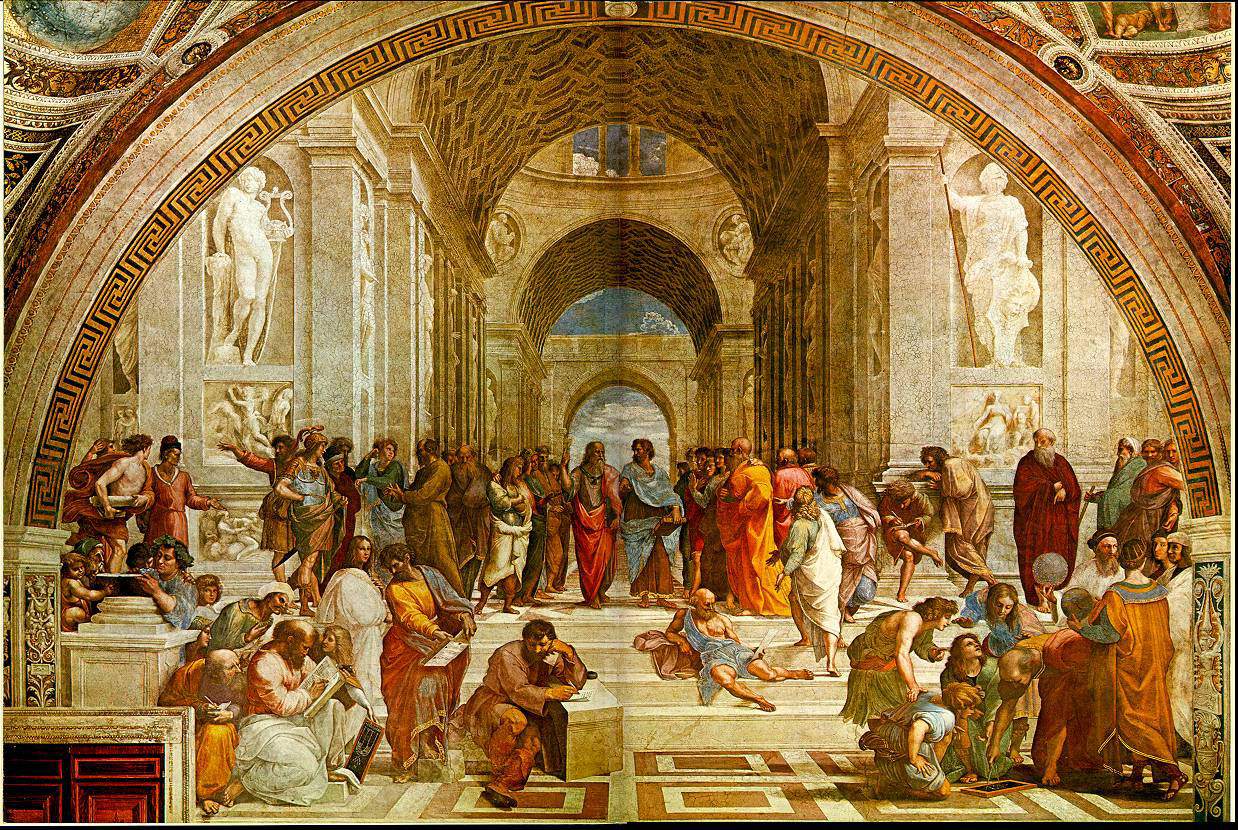
Raphael. The School of Athens. http://tomgpalmer.com/wp-content/uploads/legacy-images/School%20of%20Athens2.jpg.
Anonymous C. Stained glass cathedral window. www.fpcokc.org/aboutus/
* in order of presentation.
Bibliography
The 12th Century Renaissance. The History Guide. October 11, 2006. http://www.historyguide.org/ancient/lecture26b.html.
Age of Pericles. Wikipedia. April 21, 2009. http://en.wikipedia/wiki/Age_of_Pericles.
Akhenaten. Egyptology Online. 2008. http://www.egyptologyonline.com/akhenaten1.htm.
Anonymous A. Venus de Milo. http://www.mlahanas.da/Greeks/Arts/VenusMilo2.jpg.
Anonymous B. Arabesque. http://krsparks.files.wordpress.com/2009/02/frieze.jpg.
Anonymous C. Stained glass cathedral window. www.fpcokc.org/aboutus/
Castiglione, Baldassare. The Book of the Courtier. Trans. George Bull. London, England: Penguin Books Ltd., 1967.
Charlemagne and the Carolingian Renaissance. The History Guide. October 11, 2006. http://www.historyguide.org/ancient/lecture20b.html.
Florence Cathedral. Wikipedia. April 16, 2009. http://en.wikipedia/wiki/Florence_Cathedral.
Garland, R. Close Encounters. Lecture from series: The Integrated History of Ancient Greece and Rome. http://www.torrentreactor.net/torrents/2655216/The-Integrated-History-of-Ancient-Greece-and-Rome.
The Greco-Persian Wars. Classical Ideals. July, 2006. http://www.classicalideals.com/Greco-Persian%20Wars.htm.
Harlem Renaissance. World Book Reference Center. April 24, 2009. http://www.worldbookonline.com/wb/article?id=ar246340&st=harlem+renaissance.
Herodotus. Histories. Trans. A. de Selincourt. New York: Penguin Classics 1972.
Hindu Renaissance. Encyclopaedia Britannica. April 24, 2009. http://www.britannica.com/EBchecked/topic/266310/Hindu-Renaissance.
History of Augustus Caesar. http://www.historyworld.net/wrldhis/PlainTextHistories.asp?historyid=aa09.
Holister, Robert. Lecture. Viderunt Omnes. November, 2008.
Homer, translated by Robert Fagles. The Iliad. Middlesex, England: Penguin Books Ltd., 1998.
Italian (Petrarchan) sonnet. Wikipedia. April 22, 2009. http://en.wikipedia.org/wiki/Sonnet#Italian_.28Petrarchan.29_sonnet.
King Kalakaua. Aloha-Hawaii.com 2004. http://www.aloha-hawaii.com/hawaii/king+kalakaua/.
Michelangelo. The Creation of Adam. Sistine Chapel. http://www.success.co.il/knowledge/images/image-michelangelo-god-creates-man.html.
Morgan, Michael Hamilton. Lost History: The Enduring Legacy of Muslim Scientists, Thinkers, and Artists. Washington, United States of America: National Geographic Society, 2007.
Raphael. The School of Athens. http://tomgpalmer.com/wp-content/uploads/legacy-images/School%20of%20Athens2.jpg.
Urban Renaissance. Wikipedia. September 18, 2008. http://www.wikipedia.org/wiki/Urban_renaissance.
Walker, R. 1998. World Civilizations: A Comparative Study. p. 213-216, p. 260-286, p. 333-335. Oxford University Press, Don Mills.
What was the Islamic Golden Age? Wise Geek. 2009. http://www.wisegeek.com/what-was-the-islamic-golden-age.htm.